
How to Search Criminal Dockets
First figure out which court level holds the record. Misdemeanors, non-uniform citations, conservation violations, and the preliminary stage of a felony sit in Etowah District Criminal. Indicted felonies and appeals from District Court or municipal courts sit in Etowah Circuit Criminal. For remote lookup, the Just One Look service sells case-by-case access to trial courts, and Alacourt.com offers subscriptions with case details and images. Neither is an unlimited free search.
You can also go through the clerk. The Etowah County Circuit Clerk provides a free public-record name-search terminal in Suite 202 of the Judicial Building, and counter staff can print a copy once the case comes up. Callers should reach the right criminal division. A mailed copy request on the official form works for anyone who cannot visit. Each channel fits a different search problem.
- Identify District or Circuit Criminal from the charge and case stage.
- Search Just One Look, Alacourt.com, or the free Suite 202 terminal by name or case number.
- Match the court, case style, charge, and filing period before opening the record.
- Read the newest setting, order, plea, and disposition entries in date order.
- Call the division or submit a written request when a certified or filed document is needed.
Etowah Criminal Docket Numbers Change
One felony can leave two linked Etowah County criminal docket records. District Court takes the first appearance and preliminary process. If the grand jury indicts, the Circuit Clerk opens a fresh Circuit Court case number. The District number never converts into the Circuit number. Stop at the first record and you may miss the arraignment, motions, plea or trial settings, and the final Circuit disposition.
List both numbers on a copy request when you have them, and note that the two records belong to a single prosecution at different levels. With only one number, give the defendant name. Add the approximate filing period, the charge, and the likely division. A sound search chain runs case number first. Then try name variations and a wider filing window. Add the other court level, a call to the clerk, and then the terminal or a written request.
Etowah criminal docket flow: District complaint › preliminary stage › grand-jury review › Circuit indictment › new Circuit number.
What a Criminal Docket Shows
Think of the criminal docket as a dated index with a status history, not the full evidence file. Public fields can name the court and division, record counsel appearances, show bond information where public, and track the case from charge through disposition. What you can see still depends on the case and Alabama confidentiality rules.
| Case Number | The District or Circuit identifier, such as the number shown in a court record as Etowah District or Circuit case number. |
|---|---|
| Charge | The offense description and classification, with an indictment event when applicable. |
| Parties and Counsel | The State, defendant role, appointed or retained counsel, and recorded appearances. |
| Settings | Arraignment, plea, motion, jury, nonjury, or other scheduled court events. |
| Disposition | Acquittal, conviction, dismissal, nolle prosequi, sentence, or appeal entries as applicable. |
Money may appear too, including costs, fines, restitution, and payments. A docket line citing an order does not give you every term of that order. When exact wording controls the outcome, request the signed document itself.
Etowah Criminal Docket Discovery Gap
Discovery sits outside the Circuit Clerk's criminal record. It moves through counsel, not as a public evidence file behind each docket line. So a docket can list a filing or hearing. Yet it displays no police reports, recordings, witness material, or the full proof in the case.
Once counsel appears in Circuit Criminal, notices and case communications go to that lawyer, whether appointed or retained. Participants should bring discovery and current-notice questions to counsel. The clerk can confirm what the filed docket shows and explain court operations and scheduling. The clerk cannot predict an outcome. Nor can the clerk apply law to a deadline or grant private access to the judge.
Etowah Criminal Docket Bind-Over
A felony preliminary record may show a hearing request. It may also show a bind-over event or movement toward grand-jury review. Local process also allows automatic bind-over after 30 days when nobody requests a preliminary hearing. Bind-over is not a Circuit conviction. It only marks movement from the District preliminary stage toward possible indictment.
Grand-Jury Week is not a daily public list. It is part of the term calendar, not a roster of defendants or trials. Look for an indictment and a new case number. These appear in later Circuit entries. If nothing appears, ask the criminal division to check both court levels.
Stages on a Criminal Docket
A local criminal case can open with an arrest, a warrant, or a complaint. Early proceedings cover rights, counsel, and release. They may include a possible preliminary hearing. A felony may then be bound over for grand-jury review. An indictment starts the Circuit phase. That phase brings arraignment, plea, motions, and a trial or negotiated disposition. Sentencing and any appeal come later.
Docket flow: Filing › Arraignment › Pretrial › Plea or Trial › Disposition › Sentencing.
Old settings can stay on the docket after a continuance. Read events in order and find the newest notice or signed order. A dismissal ends the charge as filed. Nolle prosequi is the prosecution's formal choice, under court procedure, not to continue it. An acquittal records a not-guilty judgment.
Etowah Criminal Docket Setting Terms
The filed Sixteenth Judicial Circuit calendar uses broad work blocks, and each Circuit Criminal judge keeps an individual docket. Setting labels describe the kind of court work planned for a period. They do not name every defendant, time, or courtroom. They also never replace a case notice.
- Arraignment
- The hearing where the charge and plea are addressed.
- Felony Plea Week
- A calendar block grouping felony plea matters.
- Criminal Jury
- A block for criminal trials decided by a jury.
- Grand-Jury Week
- A period for indictment review, not a public daily trial list.
- City or District Appeal
- A Circuit setting after a lower-court disposition is appealed.
Confirm the actual Etowah County criminal docket setting through the latest notice, counsel, the case detail, or the correct division. A broad calendar block is only a planning layer.
Which Court Holds Criminal Dockets
Knowing the split between courts saves time. Etowah District Court keeps misdemeanors, state and county citations, and the early hearings on felonies. Once a felony is indicted, Etowah Circuit Court takes over. It also handles criminal appeals from District and municipal courts. City ordinance charges and city-police misdemeanors start at that city's municipal clerk instead. When a name search comes up empty, this division of labor is the first thing to check.
Call before you travel. The Circuit Criminal desk answers at (256) 549-5437. Related lines sit at (256) 439-6033, (256) 549-5444, and (256) 549-5438. District Criminal lists (256) 549-5441, (256) 549-5491, and (256) 549-5434. Staff can tell you which division holds a file. They can also read the latest recorded setting. But a phone answer is not a certified record. Nor will it excuse a missed court date.
Federal cases live elsewhere entirely. The Northern District of Alabama runs its own separate federal system. So an Etowah criminal docket never shows federal charges.
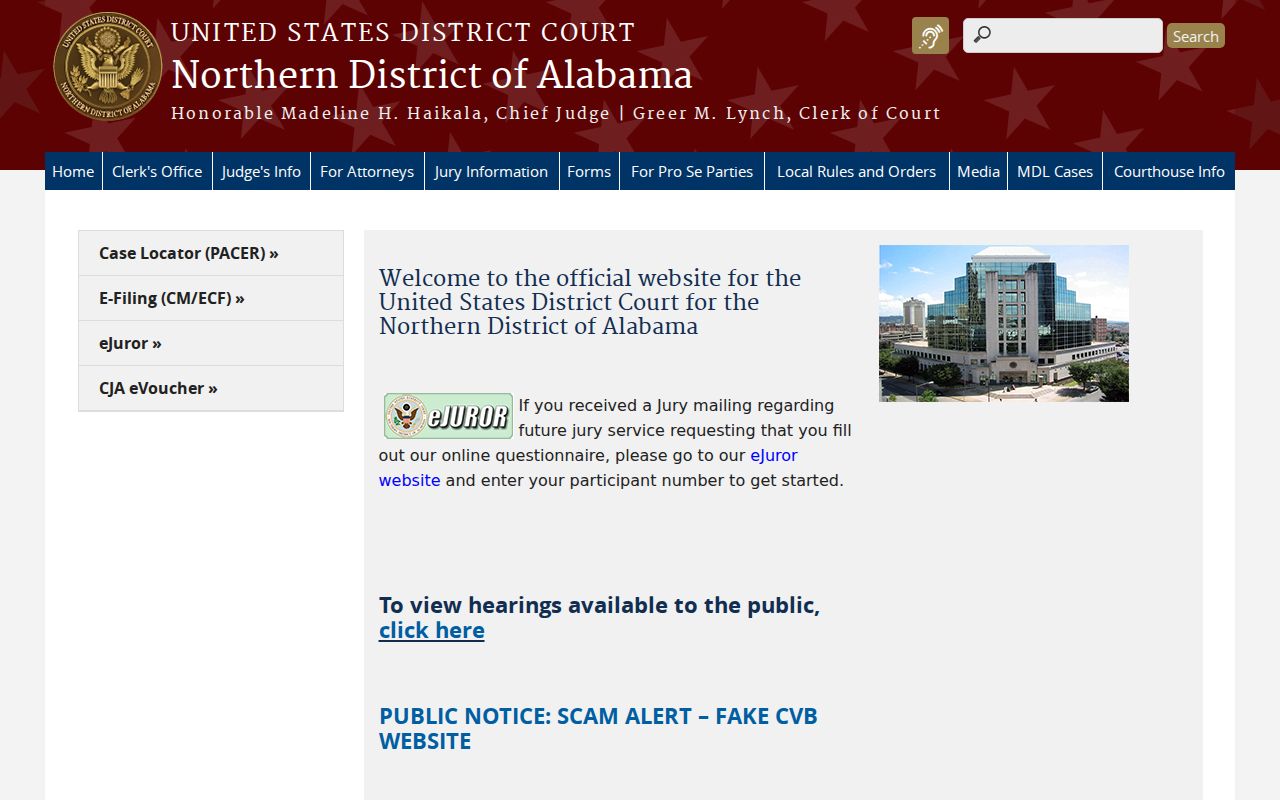
That federal site marks the line between Etowah County state trial dockets and filings made in federal court.
Etowah Criminal Docket Payment Split
Paying a fine is not the same as reading a docket. Etowah District criminal payments can go through approved channels. But a payment service only resolves an eligible balance. It does not show the full run of charges, settings, motions, and disposition. The verification fields a payment site demands are private, too. They are not public search fields.
The official AlaPay service shows how Alabama keeps this payment route apart from record access.
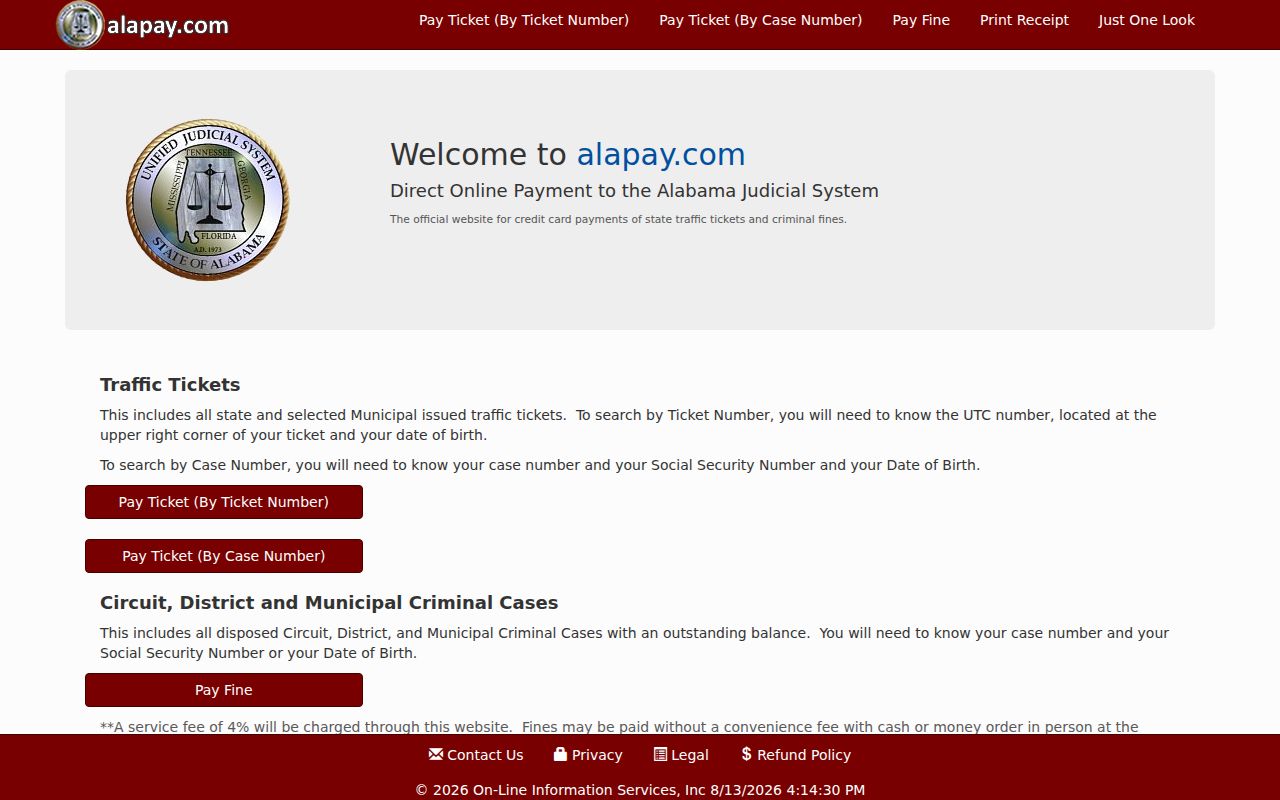
That interface settles an eligible payment. For Etowah County criminal docket details, other tools serve you better. Just One Look, Alacourt.com, or the clerk's office remains the right path.
Pay in person at the District criminal counter. Cash, a money order, a cashier's check, or a credit card all work. Personal checks are not accepted. A mailed payment should include the case number and an approved form of payment. None of this changes a court date, and none of it opens discovery.
Etowah Criminal Docket Direct Access
The Circuit Clerk's free public terminal is the best no-subscription route. It serves an Etowah criminal docket search well. You will find it in Suite 202 at 801 Forrest Avenue in Gadsden. It is open during the Judicial Building's posted hours of 8:00 a.m. to 5:00 p.m. Bring exact name spellings, the likely division, the charge type, and a date range. Once the terminal shows the case, ask at the counter. Request the docket sheet or any named filed item there.
You can also use written requests, mailed or hand-delivered to that same office. Mark the form Circuit Criminal or District Criminal/Traffic, and say whether you need certification. Processing can run up to 30 days, so precise requests help. An archived or microfilmed search costs $25 per case. Copies run $5 total for 1 through 20 pages, then $0.50 per page after that. Clerk certification adds $5 per file or document plus postage.
Federal records take a different door again. The Northern District CM/ECF system is that court's own filing and docket platform.
Its separate login shows that Etowah County Circuit and District records stay inside Alabama's state-court channels.
Etowah Criminal Docket Appeal Blocks
Etowah's term calendar splits jury from nonjury settings. It covers criminal appeals out of city and District Court. An appeal moves the case into Circuit, which creates new Circuit docket activity. The original municipal or District record stays where it began.
Keep the two numbers straight. The lower-court number and the Circuit appeal number are separate records. A calendar block offers helpful context. But the latest appeal notice gives the actual date, judge, time, and place for the case.
Public Access and Sealed Criminal Dockets
Most Etowah County criminal docket material is open to the public. Open does not mean free, remote, or complete, though. Alabama court rules can shield juvenile records, confidential identifiers, sealed material, and anything a judge has restricted by order. The Etowah copy form is blunt on this point. Confidential documents go only to an actual party, with identification.
Key rules:
Alabama Court-Record Privacy Rules 101 through 104 state the general access framework and its limits.
Rule 33 of the Alabama Rules of Judicial Administration preserves clerk-office inspection while placing electronic court data under AOC control.
Alabama juvenile-record provisions restrict access to protected juvenile material.
A blank online result proves nothing. The case may sit in another court, sit in an archive, lack remote access, or be sealed or confidential. Ask the clerk whether a public case header or a nonconfidential docket notation survives. No records request can get around a sealing order.
Etowah Criminal Docket Workload
The Etowah County Circuit Clerk logs roughly 20,000 new Circuit and District filings a year. Those spread across ten divisions. Volume like that rewards preparation. A clear case number and division will speed any request. It also explains why a criminal desk line beats the general switchboard. Use it when your main question is which court holds the record.
Four Circuit judges and two District judges work from the Etowah Judicial Building. Each Circuit Criminal judge runs an individual docket. The filed term calendar then groups the work into broader plea, trial, arraignment, grand-jury, and appeal blocks.